A c.£160 billion global recruitment market
According to data from Staffing Industry Analysts, on a net fee income basis, the global market for Permanent placement and Temporary & Contracting grew by 2% to c.£160 billion in the 12 months to December 2025.
Our portfolio of 16 countries accounted for approximately two-thirds of the global market in 2025
Our six core specialisms accounted for 60% of the global market in 2025
Managed Service Provision and Recruitment Process Outsourcing added a further c.£11 billion. These figures do not include Statement of Work or candidates recruited directly by in-house human resources departments which may present a future source of growth in the long term.
Despite the challenges of the past three years, the underlying market is still attractive, with continuing client needs and some favourable trends for Hays, including the ongoing shift from Permanent to flexible labour. The global Permanent placement and Temporary & Contracting market is expected to grow at a 3.4% compound annual growth rate through to 2030 with the latter supported by powerful megatrends including: growth in flexible, high-skill, non-Permanent careers; changing jobs and skill shortages; demographic changes and increased employee demands; and changing societal demands.
Six global and several local specialisms
Hays will invest to grow and build leadership in six global specialisms: Technology, Finance, Construction & Property, Engineering, Life Sciences, and Human Resources.
In each instance, there is a large and growing market opportunity supported by long-term megatrends and Hays currently has a leadership position, or a credible path to leadership, over the short term. In addition, Construction & Property, Engineering and Life Sciences are more resilient to possible AI-related disruption.
It is unlikely that any geography will swiftly build scale in all six of these specialisms, but each country, or country cluster, will extend or target leadership in at least one or two based on its current areas of strength and market outlook. We will double up where we are current market leaders and selectively invest in sub-scale specialisms only where Hays has an ability to establish a leading position. Countries may offer an additional one or two specialisms beyond this (for example, Office Support or Resources & Mining), to reflect the composition of their local labour markets, where there is an attractive opportunity and there is a clear path to leadership.
- In Germany, we are the market leaders in Technology, Finance and Life Sciences and near followers in Engineering and Construction & Property.
- In ANZ, we are the market leaders in Finance and Office Support, and near followers in Construction & Property.
- In UK&I, we are near followers in Finance and Construction & Property.
|
Global specialisms
|
|
Technology
Software development, data, cybersecurity, and infrastructure, spanning technical
delivery through to digital transformation leadership
|
|
Finance
Accounting, audit & control, financial services & insurances, banking, and commercial,
spanning transactional support through to senior governance and performance roles
|
|
Construction & Property
Project development and property management, spanning trades and site operations
through to infrastructure and project leadership
|
|
Engineering
Engineering disciplines, manufacturing, and process/production, spanning technical
operations through to senior design and project engineering
|
|
Life Sciences
Pharmaceuticals, biotechnology, medical devices, and healthcare, spanning research,
development, and regulatory functions
|
|
HR
Talent acquisition, employee relations, and organisational development, spanning
operational HR through to strategic people leadership
|
|
Local specialisms
|
|
Office Support
Executive support, office management and operational coordination
|
|
Resources & Mining
Blue-collar workers and professionals across natural resources, mining, oil & gas, and
energy, spanning field operations and technical roles through to senior project and
engineering leadership
|
|
Education
Teaching, support and leadership roles across primary, secondary, SEN and early years
|
Global Specialisms Table
Global
specialisms |
Relative AI
resilience |
Resilience to other
megatrends |
Other megatrends |
| Technology |
Medium |
High |
- Cybersecurity/data protection
- Cloud/digital transformation
- Enterprise tech modernisation
|
| Finance |
Medium |
Medium |
- Regulation, controls, audit and tax burden
- Cost pressure on corporate functions
|
Construction
& Property |
High |
Medium/High |
- Housing shortages
- Ageing infrastructure and asset renewal
- Public sector budget pressure
|
| Engineering |
Medium/High |
Medium/High |
- Energy transition
- Ageing infrastructure and asset renewal
- Capex slowdown from macro uncertainty
|
| Life Sciences |
Medium/High |
High |
- Ageing populations
- Healthcare demand growth
- Pharma innovation
|
| HR |
Medium |
Medium |
- Workforce transformation
- Labour regulation complexity
- Cost pressure on corporate functions
|
We are specialists in higher-skilled employment
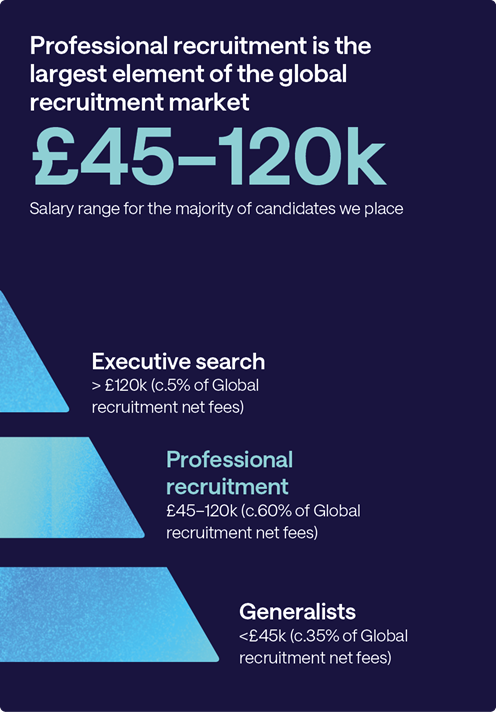
Hays focuses on the most skill-short specialist employment areas including Technology, Finance, Construction & Property, Engineering, Life Sciences, and Human Resources. Most of the candidates we place earn between £45,000 and £120,000 per annum.
Individual labour markets have their own nuances but we estimate that in aggregate these professional positions account for approximately 60% of net fees generated by the global recruitment industry. The remainder includes suppliers of lower salary blue-collar and clerical positions, and executive search. We rarely address the senior executive market because this is well served by existing executive search firms with established brands, relationships and candidate pools; or low-salary junior positions because the net fee potential is too low. Where we do place lower skilled roles, these are served with a fit-for-purpose delivery model and minimum placement fee.
The sweet spot for Hays is a combination of high-value, hard-to-fill roles with a high cost of failure where the client hires regularly and is willing to pay for quality and speed. In addition, these roles are less exposed to job automation from AI than entry-level professional roles.